Secluded Retreats in Portugal
Portugal has an unusual amount of empty country for a small nation, and a habit of putting guests in buildings that were something else first. These are the places you cannot walk to a shop from.
Portugal · Published August 2026 · 12 min read
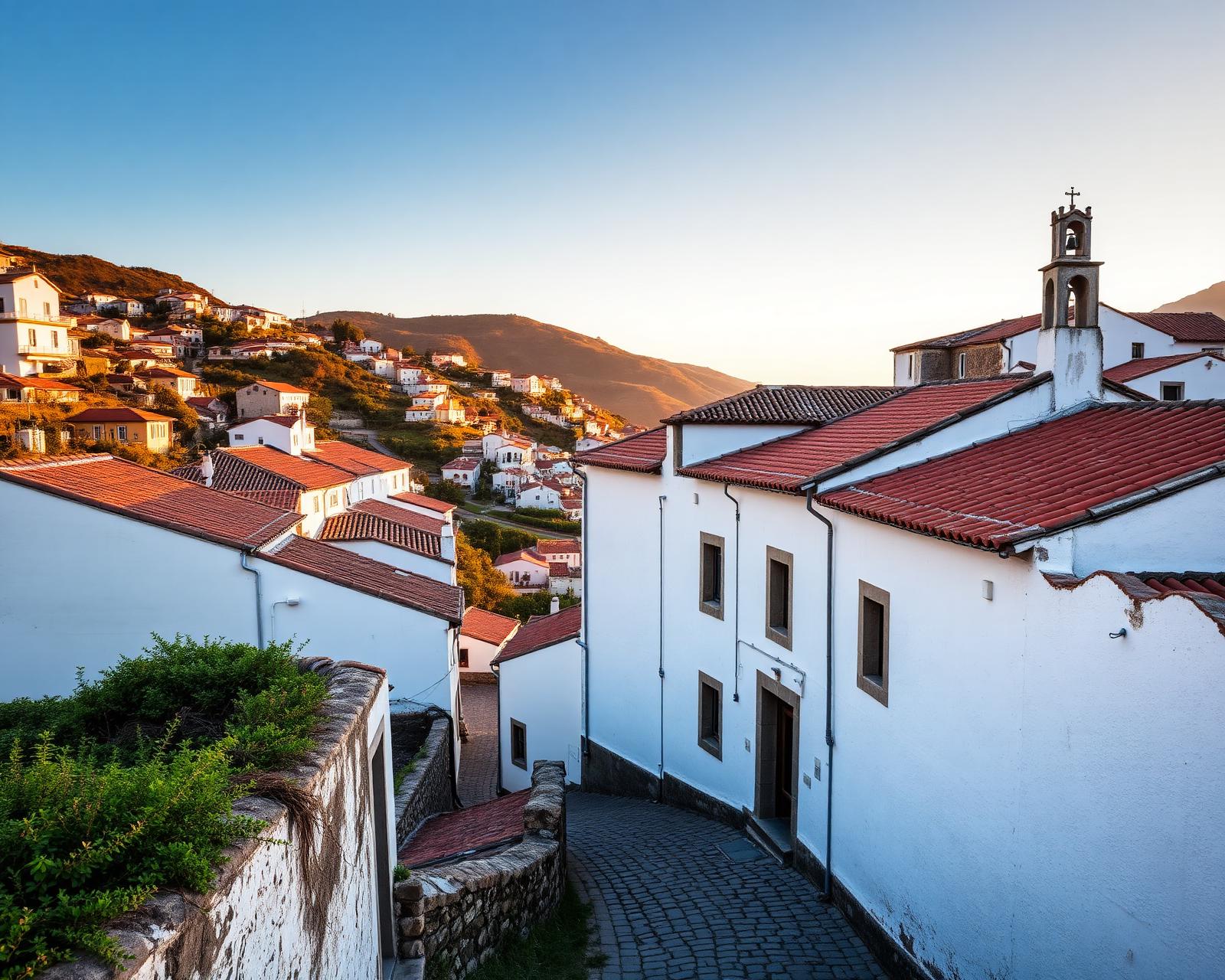
Portugal is a small country with a surprising amount of nothing in it. The interior emptied out across the twentieth century — to Lisbon, to France, to Newark and Toronto — and what it left behind is a landscape of villages at half capacity, farms that stopped farming, and whole hamlets that stopped altogether. Some of that emptiness has since been restored, one building at a time, and rented out.
This is a guide to the places to stay that are genuinely far from things. Not "peaceful" in the brochure sense, not a spa hotel on the edge of a town — far. Several of the properties here are the only building in sight. Three of them cannot be reached by road at all. One is an entire village that was abandoned in the 1960s and put back together house by house.
The Algarve is deliberately absent; it has its own guide. What follows runs from the Alentejo plains to the Azores, and almost everything in it was something else first — a sanatorium, a carob farm, a Jesuit estate at the foot of a sea cliff, a port quinta, the schoolteachers' house in a border village.
Nothing here quotes a price, nothing was chosen because it pays a commission, and nothing is included that could not be verified against the property's own account. Where a place has a constraint worth knowing — a season, a whole-house-only rule, a road that does not arrive — it is stated, because that is the detail that decides the booking.
What "secluded" means in a country this size
Portugal is roughly the size of Indiana with a fraction of its interior population density, and the emptiness is concentrated. The Alentejo has stretches where the nearest village is twenty minutes away and the nearest supermarket forty. Trás-os-Montes has a saying about its own climate — nine months of winter, three of hell — that doubles as an explanation of why people left.
So seclusion here is rarely engineered. It is what was already there. The buildings that take guests are the ones that survived: montes on the plain, quintas above the Douro, schist houses in the Beira mountains, granite houses in the Minho, and on the islands, whatever could be reached.
One consequence worth planning around. Almost every property below is self-catering or serves meals on site, because there is no alternative, and several say so outright. Assume you will not be popping out for dinner.
The Alentejo interior
The Alentejo is the emptiest part of mainland Portugal and the easiest to underestimate: cork oak, wheat, granite outcrops, and towns on hills visible from thirty kilometres away. It is also the darkest. The Dark Sky® Alqueva reserve covers eleven Portuguese municipalities around the Alqueva lake and was certified by the Starlight Foundation as the first Starlight Tourism Destination in the world, later extended across the Spanish border.
Barrieiro – Art & Nature sits at Reveladas near Marvão, inside the Parque Natural da Serra de São Mamede. The sculptor Maria Leal da Costa has spent about thirty years placing large-scale work across the estate, so the grounds function as a sculpture park as well as a farm. Eight rooms, granite hillside, cork oak and chestnut, and the walled town of Marvão seven kilometres away on its crag.
Monte da Eirinha, near São Sebastião dos Carros, is about twelve kilometres from Mértola on the boundary of the Parque Natural do Vale do Guadiana — sixty-nine thousand hectares of stony grazing country whose highest point reaches only 370 metres. The restored monte buildings sleep a maximum of twenty-four between two houses and two apartments, and six georeferenced walking and cycling routes start at the door.
Casa no Tempo, near Arraiolos, is the outlier: an inherited family farmhouse on the cork plain that the architect Manuel Aires Mateus gutted and rebuilt into whitewashed volumes, clay tile floors and a four-hundred-square-metre reflecting pool that is also the swimming pool. Four suites, and it is let only as a whole house, regardless of how many of you there are.
The Alentejo coast and the Odemira hinterland
North of the Algarve the coast continues for another hundred kilometres inside the Parque Natural do Sudoeste Alentejano e Costa Vicentina, and the country behind it — the Odemira and Santiago do Cacém interior — is emptier than the shore.
Herdade da Matinha, in a valley below the Serra do Cercal and fifteen kilometres from the beaches, was taken on with no water and no electricity and rebuilt into a country house with a serious kitchen. The directions are the best thing about it: a kilometre after Cercal, turn right onto a dirt road in front of a small factory and continue for about three. The house says of that road that it is intentional.
Monte do Papa Léguas, at Alpenduradas, is a traditional coastal monte among umbrella pines, two kilometres from Zambujeira do Mar and directly on the Rota Vicentina corridor — the Fishermen's Trail runs the clifftops, the Historical Way runs inland.
Quinta do Barranco da Estrada is not on the coast at all but on the shore of the Santa Clara reservoir behind it. Ten units, a two-acre garden running down to warm fresh water, canoes and paddleboards as part of a stay — and the whole place runs on solar. The owners note that they are often out on the lake and prefer to be emailed.
The Serra da Estrela and the schist mountains
Between the Tagus and the Douro the country rises into schist and granite, and the villages built from it are the darkest and most vertical in Portugal. Several belong to the Aldeias do Xisto network, which is itself a certified Starlight destination.
Cerdeira – Home for Creativity is an abandoned schist village at seven hundred metres in the Serra da Lousã. Two befriended families began buying and restoring the houses in 2000; an arts festival followed in 2006 and the village project in 2012. Eleven named guest houses now — Casa do Forno, Casa da Azeitona, Casa das Vizinhas — with workshops and a gallery. Cars park at the square by the chapel and you walk in. There is no television in any of them.
Casa das Penhas Douradas stands at fifteen hundred metres on the high plateau above Manteigas, inside the Estrela UNESCO Global Geopark, built out of the ruins of an old sanatorium and rebuilt in cork and birch. It is the founding hotel of the group that in 2012 revived the Burel Factory, the Manteigas wool mill — which is why every textile in the building is burel cloth made a few kilometres down the mountain.
Vale de Moses, in a private valley above the Zêzere country near Oleiros, is four restored xisto houses with river pools, old flour mills along woodland paths, and a glass-and-timber yoga shala over the valley. Note how it now works: after fourteen years of running their own retreats the owners hire the place to visiting teachers and groups, weekly between April and November. Only some of those weeks are open to individuals.
The Douro and the north interior
The Douro is famous and still manages to be empty five minutes off the river road. Further east and north, the Douro Superior and Trás-os-Montes are as thinly populated as the Alentejo and considerably harder to reach.
Casa do Rio Wine Hotel, at Quinta do Orgal near Vila Nova de Foz Côa, is a long low building by Francisco Vieira de Campos among organic vineyards, hanging over an orange grove. Ten rooms. Meals, tastings and river trips are arranged on site for the straightforward reason that there is nowhere else to eat. Half an hour away is the Parque Arqueológico do Vale do Côa, whose Palaeolithic open-air rock art is UNESCO-listed and visitable only on a booked guided trip.
Casa de Casal de Loivos is a seventeenth-century manor in the hilltop hamlet directly above Pinhão, in the Pereira de Sampayo family since 1733 and open to guests since 1991. Six rooms, home cooking, and a terrace over the Pinhão bend that is the reason anyone goes. Quinta da Côrte, at Valença do Douro, is a working port quinta with vine plantations documented from 1814.
Further north, A. Montesinho Turismo at Gimonde is six restored village houses at the gate of the Parque Natural de Montesinho. It is honest to say this is a village with restaurants rather than an isolated house — but it is the practical base for a park that contains Rio de Onor, the border village that shares its land, its labour and half its buildings with Spain.
Casa da Cisterna is inside the walls of Castelo Rodrigo, one of the twelve Aldeias Históricas, and takes its name from the village's ancient water cistern, which is now the swimming pool. It is run by two biologists who guide Côa rock-art and steppe-bird trips. Breakfast has no time restriction; dinner happens only if you ask in advance.
Peneda-Gerês and the border villages
Portugal's only national park runs along the Spanish border in the far north — granite, oak, waterfalls, and the wettest weather in the country. The villages inside it kept a transhumance system of summer and winter settlements, the brandas and inverneiras, within living memory.
Casa do Quinteiro is in Peneda itself, the hamlet that exists around the great baroque pilgrimage staircase and sanctuary at the head of the valley, under the granite wall of the serra. Two bedrooms, six people, whole house, self-catering — and self-catering is not a style choice up there. The Rio Peneda runs below for swimming.
SoajoNature is two restored granite houses in Soajo, beside the espigueiro cluster — the raised stone granaries on stilts, the oldest dated 1782 — overlooking the Lima valley. Whole-house lettings only, no meals, reservations handled personally.
The walking here is the most serious in Portugal. The GR 50 crosses the park in nineteen stages; the GR 1 is a seventy-six-kilometre circuit of the Peneda and Soajo ranges. For the villages themselves, see our guide to hidden villages in Portugal.
The islands, where seclusion is structural
On the Atlantic islands isolation is not a choice anyone made. It is geology and weather, and it produces the three most genuinely remote places in this guide. More on the archipelagos in our guide to the islands off the coast of Portugal.
Fajã dos Padres is a Jesuit-founded agricultural terrace at the foot of a three-hundred-metre sea cliff on Madeira's south coast, and no road reaches it. You descend by cable car — running 10:00 to 20:30 from late June to mid-September, and 10:00 to 18:00 the rest of the year — or you arrive by boat. The estate still grows Malvasia vines, mango, banana and avocado, and the guest houses are the rehabilitated colonists' residences, haylofts and a fishing-equipment warehouse. There is a restaurant on the beach, which is fortunate.
Aldeia da Cuada, on Flores, is a whole village. It was founded in 1676, and the earliest surviving record is a marriage entry from November 1705; by the nineteenth century a hundred and twenty-two people lived there in twenty modest houses. In the 1960s they emigrated, mostly to America, and left it. Sixteen houses have since been rebuilt along the original construction lines, and there is a restaurant, because there is nothing else in Cuada.
Caldeira Guesthouse sits in the Fajã da Caldeira de Santo Cristo on São Jorge — a lava delta under a four-hundred-metre cliff, known for its clam beds and a right-hand point break. There is no road. You arrive on foot, by quad bike or by boat, and the guesthouse runs the quad transport for guests and luggage down the trail from Fajã dos Cubres.
Comodoro Guest House is on Corvo, the smallest municipality in Portugal — under five hundred people, one village, one crater. Flights run three times a week in winter and Monday to Friday in summer from Ponta Delgada, Terceira, Horta and Flores; the alternative is the fifteen-nautical-mile crossing from Flores by launch or on the passenger ferry Ariel, weather permitting. Lava Homes, on Pico's north coast facing São Jorge, is fourteen low basalt-and-timber houses on the lava-stone terraces by Diogo Mega Architects.
When to go, and the heat
The interior of Portugal has two seasons that matter: the one where you can walk, and the one where you cannot. Mértola and the Alqueva plain routinely pass forty degrees in July and August, and the Douro Superior around Foz Côa is worse. March to mid-June and mid-September to early November are the windows for anywhere inland.
The mountains invert it. The Serra da Estrela holds snow on the high plateau from roughly December to March and the Torre road can close at short notice; June to September is the walking season, and Manteigas is cold at night even in August. Peneda-Gerês is the wettest corner of the country from October to March, spectacular in May and June, and warm enough for the rivers in September. Trás-os-Montes has that saying about nine months of winter, and it is accurate: May, June, September, October.
The Azores have no dry season at all. June to September is warmest and calmest, April to June is peak whale migration, and flights to Flores and Corvo cancel for weather in any month of the year — never book a tight connection out of either.
Getting there
Lisbon and Porto are the mainland gateways. Roughly two to two and a half hours from Lisbon to Marvão and the Alto Alentejo; Lisbon or Faro for Mértola and the Guadiana, with Faro usually the shorter drive; Lisbon for the northern Alentejo coast and Faro for the southern end. Three to three and a half hours from either Lisbon or Porto to Manteigas. Porto for everything in the Douro, Trás-os-Montes and Peneda-Gerês.
A car is unavoidable for every mainland property in this guide. It is useless for three of them: Fajã dos Padres, the Fajã da Caldeira de Santo Cristo, and Corvo, which has one village and no need of one.
The Linha do Douro railway from Porto São Bento to Pocinho is one of the best train journeys in Europe and reaches Pinhão and Valença do Douro — but you will still need a car from the station for anything here.
The Unknown Atlas is independent. We do not accept payment for coverage — how we handle commercial links.
A practical layer
Planning this journey
- Where to stay
- Small guesthouses, restored village houses, pousadas, rural hotels, or unusual stays that fit the route.
- Best with
- A small hire car, especially for inland villages, coast roads, Alentejo, Serra da Estrela, and schist villages.
- Experiences nearby
- Guided walks, wine tastings, boat trips, local food experiences, small-group tours, or quiet cultural visits depending on the article.
- Useful add-ons
- Travel insurance, eSIM/data, offline maps, flexible ferry/flight planning, and enough cash for smaller villages.
Quiet planning notes — never a booking widget. See our disclosure.
Continue exploring
More from Hidden Places in Portugal

Hidden Places
Hidden Places in Portugal Most Travellers Miss
Beyond Lisbon, Porto and the headline beaches, Portugal keeps a quieter country of stone villages, schist hamlets, river gorges and an Atlantic coast that thins out the moment the highway turns inland.
Hidden Places
Where to Stay in the Algarve, Away from the Resorts
The Algarve most people book is thirty kilometres of resort coast. The Algarve worth staying in is everywhere else — and it is mostly farmhouses, converted outbuildings, and places with fewer than a dozen rooms.
Hidden Places
Hidden Villages in Portugal That Still Feel Untouched
Schist villages in the central hills, walled border towns, Alentejo white villages and inland Algarve squares — the small Portugal that has stayed itself.